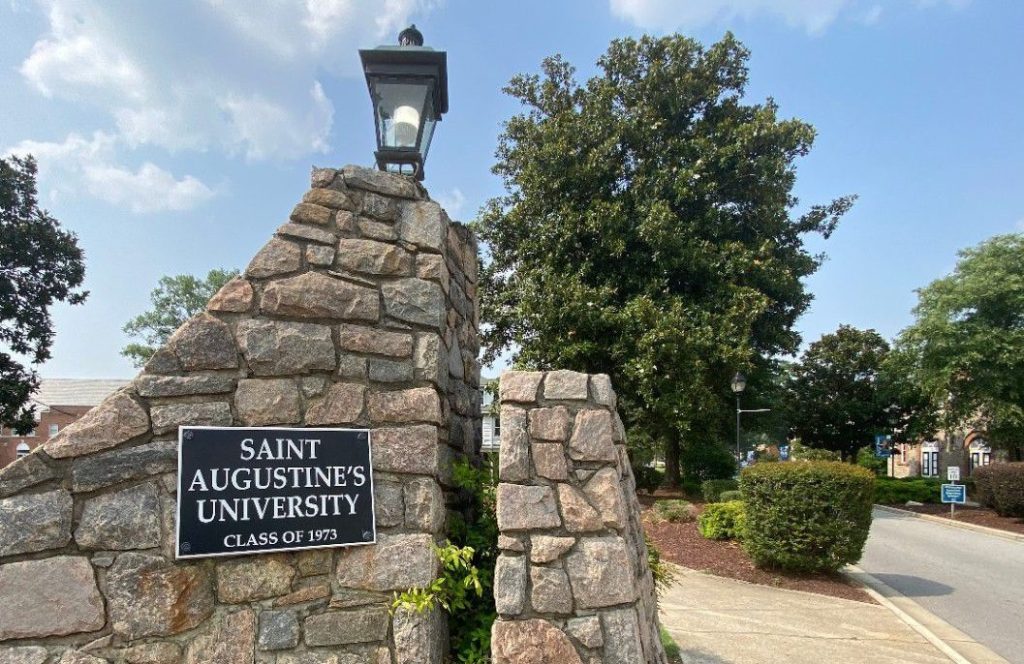
Saint Augustine’s University will offer no classes this fall as it works through bankruptcy and attempts to chart a path forward. For those of us who love HBCUs, the instinct is to say, “Save it at all costs.” But there is a question we rarely have the courage to ask: At what point does preserving an institution conflict with protecting the students it was created to serve?
The Silence on Campus
There should be students at Saint Augustine’s University right now. It is late August, the beginning of another academic year. Across the country, residence halls are reopening, parents are unloading cars, freshmen are trying to find their classrooms, faculty members are preparing syllabi, marching bands are rehearsing, and campuses are coming back to life. At an HBCU, there is something particularly meaningful about that moment. Another generation of Black students arrives on grounds built for them by people who believed they deserved an education when much of America did not.
But at Saint Augustine’s University in Raleigh, North Carolina, there will be no fall semester. The university entered voluntary Chapter 11 bankruptcy in April 2026, describing the decision as an effort to reorganize its finances and develop a sustainable path forward. SAU initially planned to generate revenue through online certificate and noncredit programs, including offerings in artificial intelligence, programming, and public health. Those plans have now been suspended, and university representatives have told the bankruptcy court that the institution will not offer educational programs this fall while it focuses on restructuring.
According to reporting from Inside Higher Ed, Saint Augustine’s is carrying approximately $74 million in debt and continues to incur substantial monthly expenses while relying on borrowed funds. During bankruptcy proceedings, Judge David Warren described the university as “essentially closed.” That phrase is difficult to read when you understand what Saint Augustine’s represents. It should also force those of us who care deeply about HBCUs to confront a question we would probably rather avoid.
Saint Augustine’s Is More Than a Balance Sheet
Saint Augustine’s University was founded in 1867, just two years after the end of the Civil War. Established by the Episcopal Church to educate formerly enslaved people, the institution emerged during Reconstruction, when Black Americans were attempting to build lives, families, communities, businesses, churches, and educational institutions in a nation still struggling with the meaning of Black freedom.
Saint Augustine’s belongs to an extraordinary generation of institutions created because Black people understood that education would be central to liberation. These colleges were not simply places to earn credentials. They became centers of Black intellectual life, professional preparation, community development, leadership, and social mobility. Generations of students walked through Saint Augustine’s doors because generations before them fought to make those doors possible.
That history explains why conversations about struggling HBCUs become emotional so quickly. When an HBCU is threatened, we are not simply discussing buildings, tuition revenue, audited financial statements, enrollment projections, or debt. We are talking about legacy. We are talking about institutions that survived segregation, discrimination, economic exclusion, and generations of chronic underinvestment. For many alumni and supporters, the idea of losing one feels like losing a piece of Black history itself.
Our instinct, therefore, is understandable: Save it. Find the donor. Raise the money. Restructure the debt. Call the alumni. Appeal the accreditation decision. Replace leadership if necessary. Find a partner. Sell property. Lease property. Do whatever has to be done, but do not allow another HBCU to disappear.
I understand that instinct. I share much of it. But loving HBCUs requires us to ask a harder question: What exactly are we trying to save?
The Financial Reality Cannot Be Romanticized
Saint Augustine’s current crisis did not emerge overnight. The university has faced years of financial instability, enrollment challenges, leadership changes, accreditation concerns, and operational pressures. In April 2026, SAU filed for Chapter 11 bankruptcy protection, reporting liabilities between $50 million and $100 million and hundreds of creditors. Court records cited in public reporting included significant obligations to federal agencies, including the Internal Revenue Service.
The bankruptcy filing created another serious consequence. Saint Augustine’s lost eligibility to participate in federal student aid programs. For any college, losing access to federal financial aid is significant. For an institution serving students for whom Pell Grants, federal loans, and other forms of assistance may determine whether college is financially possible, the consequences are potentially devastating.
The accreditation situation has been equally serious. The Southern Association of Colleges and Schools Commission on Colleges moved to remove Saint Augustine’s membership because of financial concerns. The university challenged that decision through arbitration and litigation before eventually shifting its focus toward financial restructuring. Students who had not completed their degrees faced the possibility of having to continue their education elsewhere.
These are not simply public relations problems that can be corrected with better messaging. They are structural problems. Structural problems require structural solutions, and history alone cannot solve them.
The Question HBCU Advocates Rarely Want to Ask
There is an understandable reluctance within the HBCU community to publicly ask whether an HBCU should close. We talk about saving our institutions, supporting them, increasing alumni giving, demanding equitable state funding, expanding federal investment, and encouraging corporations and philanthropists to do more. Much of that advocacy is necessary because HBCUs have endured generations of inequitable funding, restricted access to capital, discriminatory public policy, and chronic underinvestment.
However, there is another conversation that feels almost disloyal: Is every HBCU salvageable in its current form? Perhaps the more important question is whether every HBCU should be preserved exactly as it currently exists, regardless of the financial or academic consequences.
I do not ask that question casually, and I certainly do not ask it because I want Saint Augustine’s University to close. I ask because students must remain at the center of any answer. An institution does not exist primarily to preserve its name, buildings, history, or traditions. A college exists to educate students. If an institution reaches a point where it cannot reliably provide instruction, maintain accreditation, access financial aid, compensate employees, sustain academic programs, protect student records, maintain adequate facilities, or provide students with a reasonable path toward graduation, then preserving the institution and protecting its students may eventually become competing objectives.
That is the point where nostalgia can become dangerous.
Students Cannot Become Collateral Damage for Legacy
The students deserve particular attention in this conversation because institutional crises are often discussed as though they exist primarily between presidents, trustees, accreditors, creditors, attorneys, and government agencies. Students are the ones who ultimately live with the consequences.
A college student does not have unlimited time to wait for an institution to stabilize. A sophomore cannot simply suspend her academic life while trustees negotiate with creditors. A senior who is several courses away from graduation cannot plan a career around uncertainty about whether those courses will be offered. A first-generation student whose family has sacrificed financially cannot easily absorb lost credits, relocation costs, financial aid complications, housing changes, and an additional semester or year of tuition because the institution could not stabilize itself.
This is where our loyalty to HBCUs has to become disciplined. The university matters, but the student matters more. HBCUs were created to serve Black students. Black students were not created to preserve HBCUs.
That distinction is essential. If keeping an institution technically alive begins requiring students to accept unreasonable academic, financial, or professional risk, then we have reversed the relationship between mission and institution. The institution has become the priority rather than the people the institution was created to serve.
There Is a Difference Between Closing and Failing
We also need a more mature vocabulary for discussing institutional endings. Closing a historic HBCU would be devastating, but closure does not have to mean chaos, abandonment, or erasure. Higher education has mechanisms such as teach-out agreements, institutional partnerships, mergers, consolidations, and other arrangements designed to protect students when an institution can no longer operate independently.
There may also be opportunities to preserve archives, historic properties, endowed funds, alumni records, academic programs, traditions, and institutional identity through alternative structures. In some circumstances, transformation may preserve more of an institution’s mission than an endless cycle of emergency fundraising, debt accumulation, enrollment decline, accreditation challenges, and leadership instability.
Sometimes leadership means fighting to save an institution. Sometimes leadership means recognizing that the form of the institution may have to change in order for its mission to survive. Those are not necessarily contradictory positions.
The goal should never be survival merely for the sake of survival. The goal should be mission continuity, institutional integrity, and student protection.
We Should Not Write Saint Augustine’s Obituary Yet
There is an equally important counterpoint. Saint Augustine’s University has not announced that it is permanently closing, and we should not pretend otherwise. The institution entered Chapter 11, a restructuring process designed to give organizations an opportunity to reorganize their obligations rather than immediately liquidate. University officials continue to maintain that they are working toward a sustainable future.
The institution has also taken steps to reduce expenditures while navigating bankruptcy proceedings. The process remains active, and the university deserves an opportunity to demonstrate whether a viable restructuring plan exists. An institution founded in 1867 should not be casually declared dead while that process is still unfolding.
However, refusing to write Saint Augustine’s obituary does not require us to pretend that the university is healthy. There must be space between celebration and obituary where serious analysis can occur. That is where Saint Augustine’s appears to sit today, in an extraordinarily difficult space between an institution’s determination to survive and legitimate questions about whether a sustainable operating model can be restored.
Maybe “Save Our HBCUs” Is Not Enough
For years, those of us who care about Black higher education have used the language of saving HBCUs. Perhaps we need to expand that language. Instead of waiting until institutions are in crisis, we should be talking about strengthening them before the crisis begins.
That means discussing board governance before an accreditation letter arrives, enrollment strategy before residence halls empty, unrestricted fundraising before payroll becomes uncertain, deferred maintenance before buildings become unusable, presidential succession before leadership instability becomes chronic, and internal financial controls before auditors, creditors, or federal agencies begin asking difficult questions.
It also means having serious conversations about shared services, strategic alliances, academic consortia, property utilization, technology partnerships, mergers, and other models that may allow vulnerable HBCUs to preserve their missions without assuming that every institution must continue operating exactly as it did decades ago.
Saving an HBCU should not mean waiting until an institution is standing at the edge of a cliff and then demanding that alumni, philanthropists, government agencies, or wealthy donors write a check. That is not sustainability. That is emergency response.
The Sector Must Learn From Saint Augustine’s
Whatever ultimately happens to Saint Augustine’s University, other HBCUs should study this moment closely, not from a place of judgment, but from a place of prevention. The questions should be difficult and specific. Which financial indicators began flashing red years before the bankruptcy filing? When did enrollment decline become unsustainable? What role did governance play? Were trustees receiving timely and accurate financial information? Were corrective actions aggressive enough? Were fundraising and enrollment strategies aligned with the severity of the institution’s financial condition? Did leadership changes contribute to instability? Could meaningful intervention have happened earlier?
These questions matter because Saint Augustine’s is not operating in isolation. Small private colleges across the country are facing demographic pressures, rising costs, increased competition, aging facilities, technology expenses, and changing student expectations. Small private HBCUs face many of those same challenges while also carrying the accumulated consequences of historical undercapitalization.
Historical inequity is real, and it must remain part of the analysis. But acknowledging inequity cannot prevent us from examining governance, strategy, financial management, enrollment, leadership, and institutional decision-making. We can recognize the systems that disadvantaged HBCUs while still holding our institutions accountable for the decisions within their control.
Those ideas are not mutually exclusive.
An Open Campus Is Not Necessarily a Sustainable University
Perhaps one of the most important lessons from Saint Augustine’s is that we may need to reconsider how we define institutional survival. We often measure whether an HBCU has survived by whether its name still exists and its doors remain technically open. That may be the wrong measure.
A university is more than its gates, chapel, residence halls, president’s office, athletic teams, or the name carved into a historic building. A university represents an educational promise. Students arrive with the expectation that they will learn, develop, progress toward a credential, graduate, and leave better prepared for their lives and careers than when they entered.
When an institution can no longer reliably fulfill that promise, the conversation must become larger than keeping the name alive. We have to ask how the mission, students, history, and legacy can be protected, even if doing so eventually requires us to imagine the institution differently.
The Ledger Question
So, should Saint Augustine’s University close? I am not prepared to say that. The bankruptcy process is still unfolding, and the university’s leadership maintains that it is working toward reorganization. There may yet be a viable pathway forward. If Saint Augustine’s can restructure its obligations, restore the conditions necessary to educate students, rebuild financial stability, and emerge with a sustainable operating model, its recovery could become one of the most important comeback stories in contemporary HBCU history.
But the opportunity to recover cannot be indefinite, and it cannot come at the expense of students. The more consequential question is not whether we love Saint Augustine’s enough to save it. The question is whether we love HBCUs enough to be truthful about what saving one actually requires.
At what point does the effort to preserve an HBCU stop serving the people the HBCU was created to serve?
That is a painful question, but refusing to ask it will not strengthen our institutions. If we love HBCUs, we have to love them enough to demand strong governance before crisis, financial discipline before bankruptcy, accountability before accreditation is threatened, and intervention before students are forced to leave. We have to distinguish between preserving an institution and preserving its purpose.
Saint Augustine’s University was founded in 1867 because Black people deserved access to education. More than 150 years later, that mission remains sacred. The institution is the vessel through which generations have carried that mission, but the students remain the reason the mission exists.
If Saint Augustine’s can rebuild, we should celebrate it, support it, study how it recovered, and tell that story loudly. If it ultimately cannot, our responsibility should not be to preserve an institution at any cost. Our responsibility must be to protect its students, preserve its history, honor the generations who built it, and find ways for the mission that began in 1867 to continue.
Because saving an HBCU should never become more important than protecting the opportunity that HBCU was created to provide.
The HBCU Ledger
Honoring Legacy. Recording Progress. Defining the Future.


Leave a comment